Cloud architecture diagram for Bright Raven DIaaS real-time intelligence
-
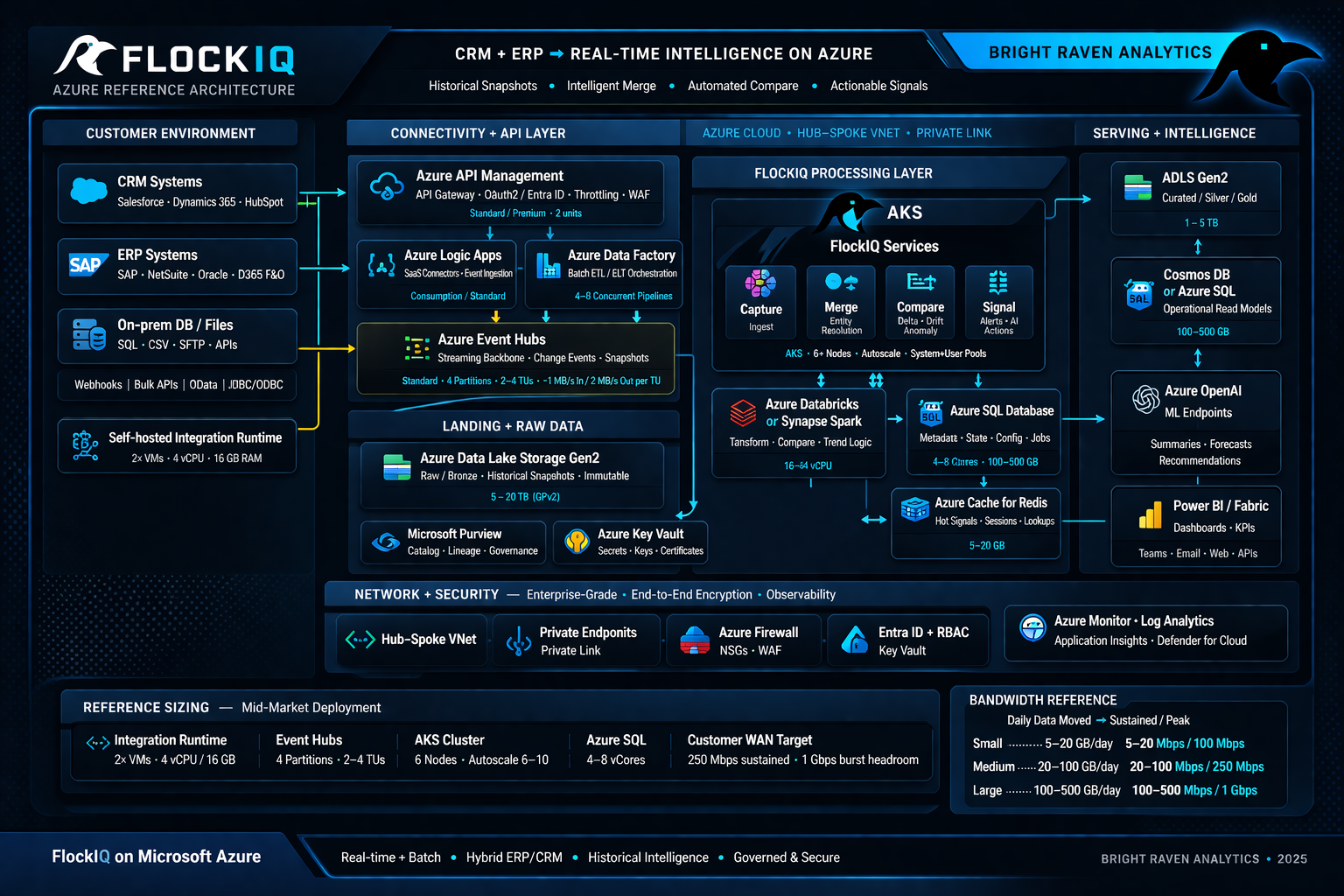
Azure Reference Architecture
Customer systems
CRM and ERP platforms expose data through REST APIs, bulk APIs, webhooks, database replication, or scheduled file exports.
Private/on-prem sources usually require a self-hosted integration runtime on customer-side VMs.
API + ingestion layer
Azure API Management is the front door for FlockIQ APIs and partner/source APIs. It supports hybrid scenarios, and Azure recommends private connectivity using Private Link/private endpoints for secure inbound access.
Logic Apps is best for packaged SaaS connectors and event-driven workflows.
Azure Data Factory handles scheduled extraction, normalization, and orchestration for bulk loads and historical backfills. Azure’s architecture guidance distinguishes ETL/ELT orchestration patterns clearly here.
Azure Event Hubs is the streaming backbone for change events, snapshots, and app telemetry. In Standard, Azure documents roughly 1 MB/s ingress and 2 MB/s egress per throughput unit, with partitions used to scale parallelism.
Storage + governance
ADLS Gen2 stores raw, conformed, and curated history.
Purview tracks lineage, schema, and governance.
Azure documents general-purpose v2 storage accounts as the current standard account type, and notes default egress/ingress scalability targets for GPv2 storage.
FlockIQ processing layer
AKS runs the FlockIQ services:
Capture: ingest snapshots and events
Merge: align records across time/system
Compare: detect deltas, drift, anomalies
Signal: generate alerts, recommendations, actions
Databricks or Synapse Spark performs heavier joins, historical compare, feature generation, and large-scale transformations.
Azure SQL Database stores metadata, jobs, pipeline status, config, mapping rules, and user/workflow state.
Redis improves low-latency retrieval for current signals and orchestration.
Serving
Curated datasets flow to Power BI / Fabric.
Operational read models can be served from Cosmos DB or Azure SQL depending on query shape.
Optional Azure OpenAI / ML endpoints add summarization, forecasting, and recommended actions.